
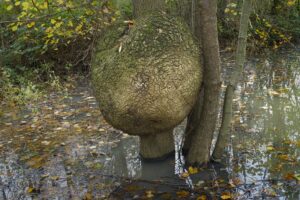
Photo: November 2023, Hørup, Als, Denmark.
Retningsforvirring hos træer
Ask er sammen med Eg to ud af en håndfuld træarter, der lettere udvikler knuder på stammen. Det vides ikke med sikkerhed, hvad årsagen er. Fænomenet udvikler sig ikke som kræft hos mennesker. Formentlig er bakterier og svampe medvirkende, men der er også en teori om, at træet under ekstrem stress kan begynde at vokse abnormt, og det lyder næsten menneskeligt.
Fx foretrækker Ask fugtig bund, men tåler ikke konstant stillestående vand (og is). Man kan forestille sig, at træet på billedet på et tidspunkt er blevet beskadiget af isen og er begyndt at udvikle knuden, der et stykke tid har fulgt stammens vækst opad, indtil træet gik ud. Døden skyldtes ikke knuden men for meget vand om rødderne.
Ændringen i væksten betyder, at veddet ikke længere kun udvikler sig vandret og lodret, men i alle retninger. I dette tilfælde er en kugleformig knude opstået koncentrisk med den oprindelige stamme. På grund af træfibrenes virvar af retninger inde i knuden, er den slags træ populært hos trædrejeren.
Directional confusion in trees
Ash, along with oak, is two of a handful of tree species that more easily develop burls on the trunk. It is not known for sure what the cause is. The phenomenon does not develop like cancer in humans. Presumably bacteria and fungi are involved, but there is also this theory that under extreme stress the tree can start to grow abnormally, and that sounds almost human.
For example, Ash prefers a moist bottom, but cannot tolerate constant stagnant water (and ice). One can imagine that the tree in the picture has at some point been damaged by the ice and has started to develop the burl, which for a while followed the growth of the trunk upwards until the tree died. The death was not caused by the burl, but by too much water around the roots.
The change in growth means that the wood no longer only develops horizontally and vertically, but in all directions. In this case, a globular burl has arisen concentric with the original stem. Due to the tangle of directions of the wood fibers inside the burl, this type of wood is popular with the wood turner.

Photo: October 2022, Bognæs, Tuse Næs, Zealand, Denmark.
Retningsforvirret træ
Denne del af en fyrrestamme forløb først vandret, men endte med at ramme jorden og slå ny rod adskillige meter fra den oprindelige stamme. Nu vokser de nye grene i alle retninger. Udløbsdatoen synes dog at være nært forestående.
Disorientated tree
This part of a pine trunk first ran horizontally but ended up hitting the ground and taking root several meters from the original trunk. Now the new branches grow in all directions. However, the expiration date appears to be imminent.