
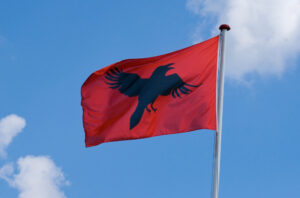
Photo: May 2009, St. Merløse, Zealand, Denmark.
Ravnefanen
Det officielle danske flag, Dannebrog, med det kristne kors (hvidt kors på rød bund) er ikke det ældste flag for Danmark.
Det ældste kendte flag er Ravnefanen med en af Odins hellige ravne (Hugin og Munin) på rød bund. Fanen var kendt vidt omkring som vikingernes mærke. Det blev anvendt af danskerne under de baltiske felttog, og op gennem vikingetiden (800‑1050) som et nationalt flag.
En hengiven gruppe af danskere foretrækker stadig Odins fritflyvende ravn frem for korset, der symboliserer Kristendommens lidelseshistorie, ved at afbilde et romersk torturinstrument. Dette instrument bestod af en plantet lodret pæl og en løs planke. Offeret arme blev bundet til den løse del, der derefter blev hejst op i pælen, hvorved de to dele dannede et kors. På baggrund af beretningen om Jesus korsfæstelse blev korstegnet et symbol for Kristendommen.
The Raven banner
The official Danish flag, Dannebrog, with the Christian cross (white cross on a red background) is not the oldest flag of Denmark. The oldest known flag is the Raven Banner with one of Odin’s holy ravens (Hugin and Munin) on a red background. The banner was known far and wide as the mark of the Vikings. It was used by the Danes during the Baltic campaigns, and throughout the Viking Age (800‑1050) as a national flag.
A devout group of Danes still prefer Odin’s free-flying raven to the cross, which symbolizes Christianity’s history of suffering, by depicting a Roman instrument of torture. This instrument consisted of a planted vertical stake and a loose plank. The arms of the victim were tied to the loose part, which was then hoisted up the stake, whereby the two parts formed a cross. Based on the account of Jesus’ crucifixion, the sign of the cross became a symbol for Christianity.