

Photo: June 2011, Smygehamn, Scania, southern Sweden.
Kalkovnen i Smygehamn
Kalkovnen i Smygehamn blev bygget i midten af 1800-tallet og står nu som minde over en storindustri i Smygehamn og Östra Torp, nemlig brydning og brænding af kalk. Produktionen af brændt kalk foregik fra 1850 til 1930. Denne restaurerede ovn har sandsynligvis været hvidkalket.
Kalkstenen blev aflejret for 135–70 mio. år siden – i Kridttiden. I området omkring Smygehamn var kalklaget op til 40 meter tykt. Lagdelt mellem kalken ligger flint. Flinten blev også udnyttet, men som fyld i bygningsmaterialer. Kalkbrydningen foregik i større skala i løbet af 1800-tallet og kulminerede i anden halvdel af århundredet. Udvindingen foregik helt frem til 1954.
I ovnen blev kalkstenen stablet i lag skiftevis med lag af kul, indgangsåbningerne blev lukket med ildfast ler og ildstedet under kalken blev tændt. Ilden brændte i 40 timer, og efter et døgns afkøling kunne ovnen tømmes for henved 200 hektoliter (20 m³) brændt kalk. Til denne proces medgik 5–6 tons kul!
Den brændte kalk blev anvendt til jordforbedring og byggeri. For de skånske huse var og er kalken væsentlig, både som kalkpuds og som hvidtemiddel.
I omegnen fandtes et titals antal ovne og flere står endnu tilbage nord for Smygehamn. Havnen i Smyge, der er fra 1922, er anlagt over et kalkbrud.
Læs her, hvordan Kalciumoxid “brændt kalk” og “læsket kalk” fremkommer i kemisk forstand. Processen kan forløbe modsat, hvilket gør brændt kalk nyttigt i mørtel, og tidligere ved kalkning af huse. Lidt kriminalhistorie: Læsket kalk er stærkt basisk, dvs. ætsende, og har traditionelt været brugt som sidste hvilested for irriterende kreditorer eller deres opkrævere. Problemet forsvinder sporløst!
The lime kiln in Smygehamn
This lime-kiln from the mid-19th century is preserved in Smygehamn as a testimony of a major industry in Smygehamn and Östra Torp, i.e. the mining and burning of lime. The production of burnt lime took place from 1850 to 1930. This restored kiln has probably been whitewashed originally.
The lime kiln in Smygehamn was built in the middle of the 19th century and now stands as a memorial to a large industry in Smygehamn and Östra Torp — namely mining and burning of lime.
The limestone was deposited for 135–70 million. years ago — in the Cretaceous. In the area around Smygehamn, the limestone layer was up to 40 meters thick. Layered between the limestone lies flint. The flint was also used, but as a filling in the building materials. Lime quarrying took place on a larger scale during the 19th century and culminated in the second half of the century. The extraction took place until 1954.
In the kiln, the limestone was stacked in layers alternating with layers of coal, the entrance openings were closed with refractory clay and the fireplace under the lime was lit. The fire burned for 40 hours, and after cooling for 24 hours, the kiln could be emptied of approximately 200 hectoliters (20 m³) of burnt lime. Five to six tons of coal was consumed in this process!
The burnt lime was used for soil improvement and construction. For the Scanian houses the lime was and is essential both as a lime plaster and for whitewashing.
In the area there were a dozen numbers of stoves and several are still left north of Smygehamn. The harbor in Smyge, which dates from 1922, was built over a limestone quarry.
Read here how Calcium oxide “burnt lime” and “slaked lime” appear in the chemical sense. The process works the opposite way too, which makes burnt lime useful in mortar, and earlier in whitewashing houses. A little crime story: Stained lime is strongly alkaline, i.e. corrosive, and has traditionally been used as a last resort for annoying creditors or their debt collectors. The problem disappears without a trace!
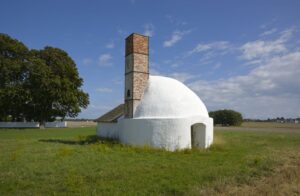
Photo: August 2010, Östra Torp, Scania, southern Sweden.
Enkelt kalkbrændingsovn med brændselshus
Kalkbrændingsovne med brændselshus er bevaret som historiske bygninger i Skåne. Produktionen af brændt kalk foregik fra 1850 til 1930. De restaurerede ovne er hvidkalkede for at vise en af den brændte kalks anvendelser.
Et andet vigtigt formål var at “gøde” med kalk for at reducere surheden af landbrugsjorden.
Single calcining kiln with stokehouse
Calcining kilns with stoke house are preserved as historic buildings in Scania. The production of burnt lime took place from 1850 to 1930. The kiln is whitewashed to show one use of burnt lime. Another important purpose was to ‘fertilize’ with lime to reduce the acidity of agricultural soils.

Photo: August 2010, Östra Torp, Scania, southern Sweden.
Kalkovne med brændselshus
Kalkbrændingsovne med brændselshus er bevaret som historiske bygninger i Skåne. Produktionen af brændt kalk foregik fra 1850 til 1930. Ovnene er hvidkalkede for at vise en af den brændte kalks anvendelser. Et andet formål var at “gøde” med kalk for at reducere surheden af landbrugsjorden.
Calcining kilns with stokehouse
Calcining kilns with stoke houses are preserved as historic buildings in Scania. The production of burnt lime took place from 1850 to 1930. The restored kilns are whitewashed to show one use of burnt lime. Another important purpose was to ‘fertilize’ with lime to reduce the acidity of agricultural soils.

Photo: August 2010, Östra Torp, Scania, southern Sweden.
Tredobbelt kalkbrændingsovn
En tredobbelt kalkbrændingsovn med brændselshuse er bevaret som et historisk anlæg i Skåne. Produktionen af brændt kalk foregik fra 1850 til 1930. Ovnene er hvidkalkede for at vise en af den brændte kalks anvendelser.
Et andet vigtigt formål var at “gøde” med kalk for at reducere surheden af landbrugsjorden.
Triple calcining kiln
A triple lime-burning kiln with fuel houses has been preserved as a historic facility in Scania. The production of burnt lime took place from 1850 to 1930. The kilns are whitewashed to show one of the uses of the burnt lime. Another important purpose was to ‘fertilize’ with lime to reduce the acidity of the agricultural soil.
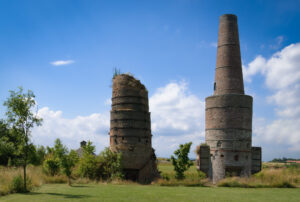
Photo: July 2008, Stevns Klint, Zealand, Denmark.
Lodrette kalkovne
Lodrette kalkbrændingsovne ved Stevns Klint.
Vertical calcining kilns
Vertical calcining kilns at Stevns Klint.