

Photo: May 2019, Gammel Pøl, Als, Denmark.

Photo: May 2019, Gammel Pøl, Als, Denmark.

Photo: May 2019, Gammel Pøl, Als, Denmark.
Gammel Pøl Fyrtårn og høfder, n
Gammel Pøl fyrtårn på Als står på den høje østvendte lerbrink mod Lillebælt. Denne kyststrækning bliver konstant eroderet af vind og bølger og er stedvis forstærket med høfder af kampesten.
Gammel Pøl Lighthouse and groynes, n
Gammel Pøl lighthouse on Als stands on the high east-facing clay brink towards Little Belt. This stretch of coast is constantly eroded by wind and waves and is reinforced in places with groynes of boulders.

Photo: July 2016, Tranerodde, Als, Denmark.
Gammel Pøl — og Tranerodde Fyrtårn, e
Gammel Pøl og Tranerodde fyrtårne på Als, og de to næsten identiske fyr på hver side af Årøsund, er af samme konstruktion og udseende, i støbejern og stål med kobbertag. Fyrene er af tysk oprindelse, opført i 1905 under den tyske administration af Sønderjylland. De blev fabrikeret hos Julius Pintsch i Berlin som gasdrevne, men efter overdragelsen til Fyrvæsenet i 1921 blev de ændret til elektrisk drift. Fyrtårnene har historisk værdi og er fredede. Vindviseren siger “1905”.
Gammel Pøl — and Tranerodde Lighthouse, e
Gammel Pøl and Tranerodde lighthouses on Als, and the two almost identical lighthouses on each side of Årøsund, are of the same construction and appearance, in cast iron and steel with a copper roof. The lighthouses are of German origin, built in 1905 under the German administration of South Jutland. They were manufactured by Julius Pintsch in Berlin as gas-powered, but after the transfer to the Danish administration in 1921 they were changed to electric operation. The lighthouses have historical value and are listed. The wind indicator says “1905”.
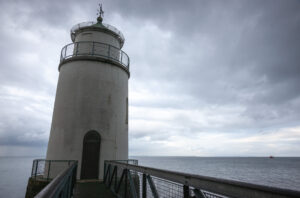
Photo: August 2016, Taksensand, Als, Denmark.
Taksensand fyr, w
Taksensand fyr på Als en overskyet dag med det fynske øhav i baggrunden.
Taksensand lighthouse, w
Taksensand lighthouse on Als an overcast day with the Funen archipelago in the background.

Photo: December 2022, Kegnæs, Als, Denmark.
Kegnæs Fyr, s
Kegnæs er en halvø på sydsiden af Als. I den sydøstlige ende ligger Kegnæs Fyr, der rækker ud over Flensborg Fjord mod syd og mod øst Det sydfynske øhav.
Kegnæs Lighthouse, s
Kegnæs is a peninsula on the southern side of Als. At the south-eastern end is Kegnæs Lighthouse, which covers Flensburg Fjord to the south and to the east the South Funen Archipelago.

Photo: September 2023, Sottrupskov, Jutland, Denmark.
Minifyr på Jyllandssiden
Dette minifyr (set fra vest) står ved landsbyen Sottrupskov på Jyllandssiden af Alssund. Fyret er bygget i 1930. Med en højde på kun 2 meter er det det mindste i Sønderborg-området. Bortset fra en mindre ændring i 1980 står det i sin oprindelige form. Fyret er af stål med elektrisk lyskilde. Det udsender farverne WRG (hvid, rød og grøn) i vinkler med lige lange lys og mørkeperioder — 2 sekunder.
I baggrunden udfører et lokalt fly start- og landingsrunder på Sønderborg Lufthavn (EKSB).
Mini lighthouse on the Jutland side
This mini lighthouse stands at the village of Sottrupskov on the Jutland side of Alssund. The lighthouse was built in 1930. With a height of only 2 metres, it is the smallest in the Sønderborg area. Apart from a minor change in 1980, it stands in its original shape. The lighthouse is made of steel with an electric light source. The small lighthouse emits color beams WRG (white, red and green) at angles with equally long light and dark periods — 2 seconds.
In the background a local aircraft conducts take off and landing exercises at Sønderborg Airport (EKSB).