
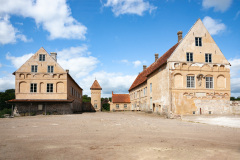
 Fra syd / South view
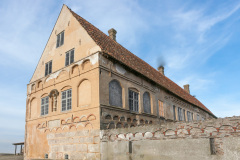 Fra sydøst / Southeast view
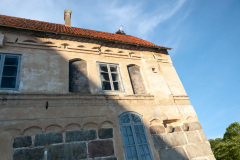 Fra øst / East view
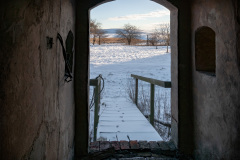 Kig mod øst / View towards East
Om Bjärsjöholms gamle slot
Bjärsjöholms gamle Slot repræsenterer Tidlig renaissance fra det 14. århundrede. Renaissancen sluttede i 1700-tallet.
Uddrag af informerende opslag på den sydvestlige gavl:
(…)
I begyndelsen af 1400-tallet kom ejendommen i slægten Rotfelts besiddelse. I 1558 uddøde slægten på sværdsiden og indflydelsen blev delt mellem fire søstre. En af dem, Cistence, gift med Björn Kaas, rigsråd og lenshøvding på Malmöhus, tog sig af gården, grundlagde et storgods og begyndte fra 1576 at bygge slottet. Det fik fire fløje og blev placeret på kanten af den daværende sø. Da søen tørrede ud, opstod der sætninger i murværket, og det blev indledningen til et generelt forfald.
Et unikt dokument fra 1680 viser, at daværende ejer Magnus Gabriel de la Gardie lod foretage en opmåling og planlagde en større ombygning.
I 1790 opstod et nyt initiativ — ejerparret Joacim Cock og Charlotta Ulrika von Essen lod den nordlige fløj rive ned.
Da det nye slot (i modsat retning) opførtes på højen med udsigt over Østersøen, fik det gamle en ny rolle som smedje, mølle, mejeri og boliger for ansatte. Lejlighedsvis var slottet inddraget til brug for hoffet og fik senere kapitalstærke ejere.
I 1847 købtes ejendommen af lagmanden Tage Sylvan, som havde omfattende økonomiske tilgange, og han lod i 1850 det nye slot opføre. Arkitekten Merdahl kom fra Danmark, og han tegnede det nye slot med inspiration fra Italien. Han ansatte Boysen som bygningschef og sidstnævnte blev ydermere stadsarkitekt i Ystad, hvor han fik betydning, da han opførte bl.a. teatret og det nye rådhus. Slottet på højen er aflukket privat ejendom.
Efter tider vekslende mellem forfald og fornyelse kom det gamle slot i 1966 i familien Ahlströms eje. Ahlström forsøgte at få bystyret gjort interesseret i at støtte vedligeholdelsen. Efter en avisoverskrift, der lød: “SLOT TIL SALG FOR 1 Kr” steg interessen hos rigsantikvaren, og der blev i 1985–86 udført en ydre restaurering i tidssvarende stil. Det er nu muligt at studere de spændende bygningstekniske løsninger fra tidligere.
Siden 1986 har slottet haft status af kulturminde. Det gamle slot indeholder et lille kapel med krydshvælv.
About Bjärsjöholms old Castle
Bjärsjöholms old Castle represents early renaissance from the 14th century ending in the 17th century.
From info-poster on the southwest gable:
(…)
At the beginning of the 14th century the property belonged to the Rotfelt family. In 1558 the sword side of the family died out, and the influence was shared by four sisters. One of them, Cistense, married to Björn Kaas, council of state and commander of Malmöhus fief, took care of the property, founded a greater manor and began to build a castle in 1576. The castle had four wings and was placed on the beach of the lake at the time. When the lake dried out, subsidence spread in the walls and this was the initiation of a general decay. (…)
A unique document from 1680 shows that the then owner Magnus Gabriel de la Gardie had a survey made and planned a major redevelopment.
In 1790 a new initiative emerged — the owner couple Joacim Cock and Charlotta Ulrika von Essen had the north wing torn down.
When the new castle (in the opposite direction) was built on the mound overlooking the Baltic Sea, the old one got a new role as a smithy, mill, dairy and housing for employees. Occasionally the castle was confiscated for the use of the court and later had capital-rich owners.
In 1847 the property was purchased by the lagman Tage Sylvan, who had extensive economic approaches and in 1850 had the new castle built. The architect Merdahl came from Denmark, and he designed the new castle with inspiration from Italy. He employed Boysen as building manager and the latter also became a city architect in Ystad, where he gained importance when he built, among other things. the theater and the new town hall. The castle on the mound is secluded private property.
After times alternating between decay and renewal, the old castle came into the ownership of the Ahlström family in 1966. Ahlström tried to get the city council made interested in supporting the maintenance. After a newspaper headline that read: “CASTLE FOR SALE FOR 1 Kr” (1 SEK), interest in the national antiquary increased, and in 1985–86 an external restoration was carried out in a contemporary style. It is now possible to study the exciting building technical solutions from earlier.
Since 1986, the castle has had the status of a cultural monument. The old castle contains a small chapel with a cross vault.